
TL;DR
- Real-time fraud detection analyzes transactions as they happen, flagging suspicious activity in 100–300 milliseconds — before funds move
- AI/ML models outperform legacy rule-based systems by up to 44% in detection accuracy while reducing false positives by 10–15%
- Behavioral analytics and device intelligence catch composite fraud patterns — failed login, new device, high-value transfer — as they unfold
- Automated responses—transaction blocks, push alerts, step-up authentication—trigger immediately when risk thresholds are crossed
- Mobile banking extends fraud detection through device fingerprinting, SIM binding, and app-layer protection via RASP
What is real-time fraud detection?
Real-time fraud detection is the continuous, automated analysis of financial transactions and behavioral signals at the moment they occur — designed to identify and act on fraudulent activity before it completes. This represents an operational shift from retrospective fraud discovery to preventive interception.
The gap it closes is concrete. Batch processing systems reviewed transactions in bulk — hours or even days after execution — meaning banks discovered fraud retrospectively, not preventively.
In an instant-settlement world where payment networks like SEPA Instant mandate 10-second end-to-end execution and UPI processes transactions in milliseconds, overnight batch windows guarantee financial loss.
Static rules engines only flag what they're pre-programmed to catch — a transaction exceeding a set threshold, a foreign IP address, a new payee. Real-time systems use adaptive, learning models that evolve with fraud patterns, detecting composite sequences invisible to rules: valid credentials used from an unfamiliar device, followed by a small test transaction, then a high-value transfer — all within 90 seconds.
The system operates in two primary modes:
- Transaction-level detection flags individual suspicious payments based on amount, merchant, geography, or velocity
- Behavioral/session-level detection monitors sequences of user actions across a session or device—tracking login patterns, navigation behavior, typing cadence, and device posture
The combination matters because sophisticated fraud rarely announces itself in a single transaction. Account takeover attacks involve a threat actor gaining access, repositioning by changing account details, then executing transfers. Only session-level detection catches this progression.
That session-level visibility becomes even more critical across channels. Card payments, mobile banking apps, internet banking, and real-time payment rails each introduce different signal types and latency constraints — but all require sub-second decisioning to intervene before a transaction settles.
How does real-time fraud detection work?
Real-time fraud detection operates as a continuous, multi-stage pipeline. Each stage contributes a layer of signal, analysis, or action that builds into a complete fraud decision—typically within 200-300 milliseconds. Mastercard's Transaction Fraud Monitoring platform, for example, delivers latency of 100-120 milliseconds in the cloud and under 10 milliseconds on-premise.
Signal capture
The process begins automatically: every user event—login attempt, transaction initiation, device change, geolocation ping—generates a data signal that enters the detection pipeline. This initiation is continuous and automated, not triggered by human review.
Data sources feeding the pipeline include:
- Transaction metadata: amount, merchant, time, currency, recipient details
- Device fingerprints: OS version, device ID, screen resolution, installed apps, jailbreak/root status
- Network identifiers: IP address, VPN detection, Wi-Fi SSID, carrier network
- Behavioral inputs: typing cadence, swipe patterns, navigation flow, session duration
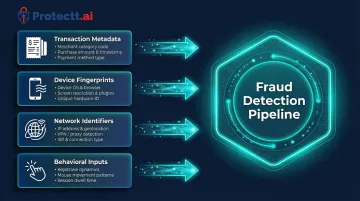
Mobile apps generate richer device-level signals than web channels—including accelerometer data, device angle, and SIM binding status—making them both a higher-risk attack surface and a more defensible channel when properly instrumented.
AI analysis and risk scoring
AI/ML models analyze incoming signals against a user's established behavioral profile and population-level fraud patterns simultaneously, producing a real-time risk score for every event.
During scoring, the model checks for:
- Anomalies: transaction amount deviating from the user's 30-day average, login from a new country
- Composite event sequences: failed OTP attempt + new device registration + high-value transfer within minutes
- Cross-account patterns: mule account detection, rapid fund movement across multiple accounts
Peer-reviewed banking studies show that ensemble ML models like LightGBM outperform traditional logistic regression by up to 44% in classifying fraudulent payments. Cost-sensitive learning models achieve a 10-15% decrease in false positive rates compared to standard models while maintaining detection rates above 90%.
Speed is enabled by models running in-memory against pre-computed behavioral baselines. Architectures using Apache Kafka for high-throughput message brokering and Apache Flink for stateful computations enable real-time fraud detection pipelines that process thousands of events per second without slowdown.
Thresholds and calibration
Risk score thresholds determine what triggers an alert, a block, or a step-up authentication request. This stage is operationally critical: over-sensitive thresholds block legitimate customers (damaging experience and conversion), while under-sensitive thresholds let fraud through.
AI-native platforms continuously retrain on outcomes to recalibrate. When a transaction flagged as high-risk is confirmed legitimate by the customer, that outcome feeds back into the model, reducing similar false positives going forward.
This adaptive loop is what separates modern ML-based detection from static rule systems.
Automated response
Transactions that exceed a risk threshold immediately trigger a pre-configured response:
- Instant transaction block: High-risk transfers are stopped before execution
- Real-time push alert: Customer receives immediate notification of suspicious activity
- Step-up verification: Biometric authentication, silent mobile verification, or device confirmation required to proceed
- Automatic account hold: Account access restricted pending investigation
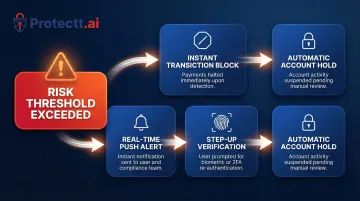
The output integrates downstream: fraud decisions feed into case management systems for investigator review, compliance audit logs for regulatory reporting, and model retraining pipelines, making the system progressively smarter after every decision.
Key technologies powering real-time fraud detection
Real-time fraud detection runs on a stack of interconnected capabilities. Four layers work in concert: AI/ML inference engines, behavioral analytics, device/identity intelligence, and app-layer runtime protection.
AI/ML inference engines
Models trained on millions of historical transactions—using gradient boosting, deep learning, or ensemble methods—run continuously in-stream, scoring risk for each event without waiting for a batch cycle. Adaptive models self-improve as they process outcomes, adjusting detection logic based on confirmed fraud cases and false positive feedback.
Behavioral analytics
Systems build individual user profiles over time: typical transaction amounts, login times, preferred devices, geolocations. Deviations trigger alerts. Behavioral analytics is especially critical for catching account takeover fraud, where credentials are valid but behavior is not.
The European Banking Authority officially recognizes behavioral biometrics—keystroke dynamics, device angle, swipe patterns—as a valid 'inherence' factor for Strong Customer Authentication under PSD2. A top-5 US bank deployed this technology to stop $300,000 in Zelle fraud in three weeks with zero false positives.
Device and identity intelligence
Device fingerprinting, SIM binding, and zero-trust device verification confirm whether the hardware and identity presenting a transaction are consistent with the registered user. Platforms like Protectt.ai embed device integrity checks and silent mobile verification directly into banking apps through lightweight SDKs—ensuring the identity signal feeding the fraud engine is trusted at the source, without OTP friction.
Silent Network Authentication (SNA) via GSMA CAMARA APIs cryptographically verifies SIM possession directly with Mobile Network Operators in 1–4 seconds, eliminating interceptable SMS passcodes vulnerable to phishing and SIM-swap attacks.
Runtime Application Self-Protection (RASP)
RASP monitors the app's own execution environment in real time, detecting tampering, emulators, overlays, and hooking attempts that would otherwise let fraudsters inject false signals into the detection pipeline.
This protection is foundational for mobile banking. Sophisticated trojans like 'Godfather' target over 1,000 banking apps globally by deploying screen overlays to steal credentials and intercept 2FA codes. RASP blocks these attacks at the app layer before they can compromise the fraud detection system itself.
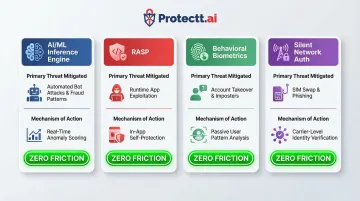
| Technology | Primary Threat Mitigated | Mechanism of Action | User Friction |
|---|---|---|---|
| AI/ML Inference Engine | Transaction Fraud | Continuous in-stream risk scoring | Zero (Background) |
| RASP | Screen Overlays / Emulators | Blocks malicious code injection at runtime | Zero (Background) |
| Behavioral Biometrics | Account Takeover (ATO) | Analyzes keystrokes, swipes, device angle | Zero (Passive) |
| Silent Network Auth (SNA) | SIM Swapping / Phishing | Cryptographic SIM-to-MNO handshake | Zero (Replaces OTP) |
Types of banking fraud real-time detection catches
Real-time detection works because each fraud type has a distinct signal pattern — and the window to catch it is measured in seconds, not minutes.
Account Takeover (ATO)
ATO fraud resulted in £39.4 million in UK losses in 2024 — and stolen credentials alone don't explain why it's so hard to stop. Real-time systems catch it by reading the composite signal: valid credential + unfamiliar device + unusual transaction sequence. Behavioral biometrics add another layer, detecting when physical interaction patterns deviate from the legitimate user's baseline even when passwords are correct.
Authorized Push Payment (APP) Fraud
APP fraud cost UK customers £450.7 million in 2024, with purchase scams driving 70% of cases. The speed of instant payments makes it particularly dangerous — funds reach the fraudster's account in seconds and move through money mule chains before any manual review is possible.
Real-time detection flags the behavioral signals that betray these scams: unusual recipient patterns, rushed transaction timing, and interaction anomalies that suggest a customer is acting under coercion rather than their own intent.
Card-Not-Present (CNP) Fraud
CNP fraud — stolen card details used for online purchases — drove £399.6 million in UK losses in 2024. Real-time detection identifies it through three signal types:
- Transaction velocity: multiple purchases placed within minutes of each other
- Geolocation mismatch: cardholder in London, purchase originating in Lagos
- Merchant category deviation: a grocery shopper suddenly transacting with an electronics retailer
Mobile-Specific Attacks
SIM swap fraud surged 1,055% in the UK in 2024; the FBI separately tracked nearly $26 million in US losses from the same attack vector. Criminals port a victim's number to a new SIM, bypassing SMS-based two-factor authentication entirely. Real-time detection counters this through SIM binding verification — confirming the physical SIM matches the registered device before any session proceeds.

Screen overlay attacks and app cloning present a different challenge. These threats operate at the app layer and require detection through RASP technology, not just at the transaction processing layer where most legacy systems focus.
Challenges and limitations to know
False positives and customer friction
Traditional rule-based systems generate high false positive rates — on average, only 1 fraudulent transaction is found for every 5 blocked by legacy systems. Overly strict fraud prevention frustrates customers: in the US, poor user experience is the primary driver of abandonment at new account creation (36% retail, 37% ecommerce).
AI reduces false positives by combining multiple contextual signals into a composite risk score, so a single unusual factor doesn't automatically block a legitimate customer. These signals include:
- Transaction history and spending patterns
- Device fingerprint and geolocation
- Behavioural baseline and session anomalies
Adversarial AI
Solving false positives is only half the battle. As AI-powered defences improve, fraudsters are adapting in kind.
Criminals now deploy generative AI to create hyperrealistic deepfake impersonations, craft personalised phishing emails, and automate attacks at scale. This industrialisation of fraud tools erodes trust in digital interactions and overwhelms traditional rule-based systems. Continuous model retraining on fresh fraud signals — rather than periodic rule updates — keeps detection ahead of these evolving tactics.
Integration with legacy infrastructure
Even well-designed fraud models face a practical obstacle: the infrastructure layer. Many banks run core systems that weren't built for real-time event streaming.
SDK-based and API-first deployments reduce the integration burden without requiring a full core system overhaul. EMV 3-D Secure, for example, uses SDKs to exchange over 135 data elements between merchants and issuers — enabling risk-based authentication without adding checkout friction.
Frequently asked questions
How can banks detect fraud in real time?
Banks use AI and machine learning models to analyze transaction data, device signals, and behavioral patterns continuously as events occur, enabling automated blocking or step-up verification before a transaction completes—typically within 100-300 milliseconds.
What is the difference between real-time and batch fraud detection?
Batch detection processes transactions in bulk after the fact, introducing hours of delay. Real-time detection analyzes each event as it happens, closing the window during which fraudsters can move stolen funds.
What is the hardest fraud to detect?
Authorized push payment (APP) fraud and AI-driven impersonation scams are among the most difficult to catch because the transaction is initiated by the legitimate account holder under deception, making behavioral anomalies subtler.
What is the 10-80-10 rule for fraud?
The rule holds that 10% of people will never commit fraud, 80% might under the right circumstances, and 10% will actively seek to. It informs risk-tiered detection strategies rather than treating all customers as equally suspect.
Do banks usually refund scammed money?
Refund policies vary by jurisdiction and fraud type. Authorized transactions—where the customer was deceived into initiating the transfer—are hardest to recover, and regulators globally are increasingly assigning shared liability to banks. Real-time interception before funds move is far more effective than post-fraud reimbursement.
How does AI reduce false positives in banking fraud detection?
AI reduces false positives by combining multiple contextual signals—transaction history, device, geolocation, behavioral baseline—into a composite risk score, so a single unusual factor (like an international purchase) doesn't automatically block a legitimate customer.