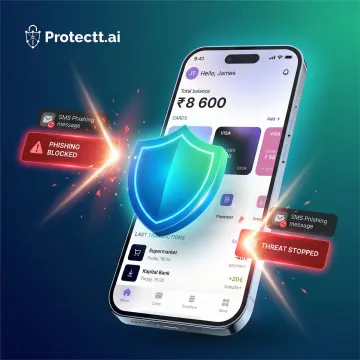
What is smishing in simple words?
Smishing is a form of phishing attack carried out via SMS text messages. Fraudsters send deceptive texts impersonating banks or fintech apps—containing malicious links or fake alerts—to trick users into revealing OTPs, passwords, or financial credentials. Once a user clicks the link or shares a code, attackers can access accounts and commit fraud without any physical interaction.
How does SMS phishing specifically target mobile banking users?
Attackers send fake SMS messages mimicking banks, payment apps, or transaction alerts, urging users to click links or share OTPs to 'verify' their account. These messages exploit the trusted nature of bank SMS notifications. Once credentials or OTPs are captured, fraudsters take over accounts, initiate unauthorized transfers, or perform SIM swap attacks to intercept future messages.
How does Protectt.ai's AppBind eliminate OTP-based smishing risk?
AppBind uses proprietary LSAP and 3-Way Hairpin technology to perform a silent, cryptographic handshake between the device's SIM and the mobile carrier network—completely bypassing SMS OTPs. Since no one-time code is ever sent or entered, there is no OTP for a smishing attacker to intercept, steal, or socially engineer from the user.
What is Silent Mobile Verification (SMV) and how does it prevent smishing?
Silent Mobile Verification (SMV) is a password-less authentication protocol that verifies mobile number possession by initiating a secure cryptographic handshake between the device's SIM and the mobile network operator—entirely in the background. It replaces the OTP shared secret with an unbreakable, network-verified fact, inherently eliminating the SMS attack vector that smishing campaigns rely on.
Can Protectt.ai's smishing protection integrate with existing banking mobile apps?
Yes. Protectt.ai's solutions are delivered as lightweight SDKs for Android and iOS that integrate seamlessly into existing mobile banking and fintech applications with minimal development effort and zero performance overhead. The no-code or low-code integration paths allow institutions to deploy comprehensive smishing protection rapidly without disrupting existing user experience or app architecture.
Does Protectt.ai's smishing protection help meet RBI, NPCI, or SEBI compliance requirements?
Absolutely. Protectt.ai is certified to ISO 27001, PCI DSS, ISO 22301, and ISO 42001, and provides purpose-built solutions for RBI Digital Payment Security Controls, NPCI SIM and Device Binding requirements, and the SEBI Cybersecurity and Cyber Resilience Framework. These solutions include automated compliance monitoring and reporting, significantly reducing the manual effort required for regulatory audits.
What sectors does Protectt.ai's smishing protection serve?
Protectt.ai serves Banking, Insurance, NBFC, FinTech, Government, Stock Trading Companies, Asset Management Companies, and Enterprise Systems. Clients include RBL Bank, Yes Bank, Bajaj Finserv, BSE, ICICI Lombard, LIC, and 20+ other leading financial institutions—all relying on Protectt.ai to protect their mobile apps and users from SMS phishing and smishing-based fraud.
How does Protectt.ai minimize false positives in smishing detection?
Protectt.ai's AI/ML-driven behavioral analysis continuously learns normal transaction and communication patterns for each user and platform. By contextualizing threat signals against behavioral baselines, the system accurately distinguishes legitimate banking SMS interactions from malicious smishing attempts—resulting in significantly fewer false positives compared to rule-based systems, without blocking genuine user activity.