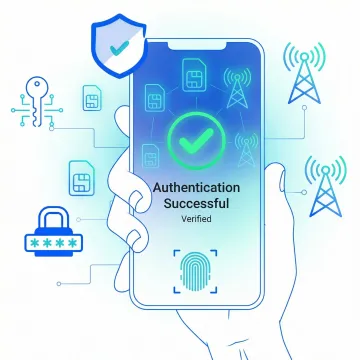
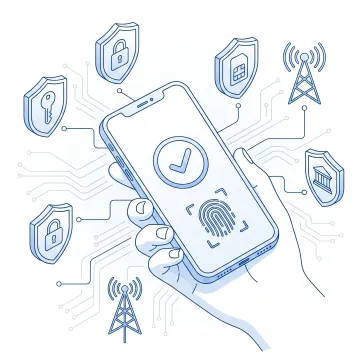
What is Silent Mobile Verification (SMV) and how does it work?
Silent Mobile Verification (SMV), also known as Silent Network Authentication (SNA), is a password-less authentication protocol that verifies a user's mobile number possession by initiating a secure, cryptographic handshake between the device's physical SIM card and the core Mobile Network Operator in the background. No OTP is sent or entered — the verification is instant, invisible, and carrier-backed, making it inherently resistant to phishing and social engineering.
How does Silent Authentication eliminate OTP fraud in mobile banking onboarding?
Traditional OTPs are intercepted via SIM swap attacks, SS7 vulnerabilities, phishing, and social engineering. Silent Authentication removes the OTP from the equation entirely. Instead of a shareable code, it uses an unbreakable, cryptographic fact — the SIM's verified presence on the carrier network. Since there is no code to steal, intercept, or manipulate, the entire class of OTP-based fraud vectors is eliminated at the architectural level.
What is the difference between Silent Mobile Verification and traditional OTP-based verification?
OTP-based verification sends a one-time code via SMS that the user must manually enter — a process vulnerable to interception, SIM swap, and phishing. Silent Mobile Verification performs the entire verification cryptographically in the background using the carrier network, with no user action required. The result is higher security assurance, zero friction for the end user, and complete immunity to social engineering attacks targeting OTP delivery channels.
Is carrier-level Silent Authentication compliant with RBI, NPCI, and other financial regulations?
Yes. Protectt.ai's Silent Authentication solutions are designed to support compliance with RBI Master Directions on Cyber Resilience and Digital Payment Security Controls, NPCI security controls on SIM and device binding, SEBI Cybersecurity and Cyber Resilience Framework, and international standards including ISO 27001, PCI DSS, and ISO 22301. The solution helps financial institutions meet evolving regulatory mandates without burdening development teams.
How quickly can Silent Authentication be integrated into an existing mobile banking app?
Protectt.ai's Silent Authentication is delivered as a lightweight, easy-to-plug SDK for both Android and iOS. It is designed for rapid integration into existing mobile banking applications with minimal development overhead. Most implementations can be deployed in days rather than weeks, allowing banks and FinTechs to achieve faster go-to-market while immediately improving onboarding security and user experience.
Does Silent Mobile Verification work without an internet connection or on all mobile networks?
Silent Mobile Verification operates via the carrier's mobile data network to perform the cryptographic handshake between the SIM and the MNO. It requires an active mobile data connection at the time of verification. Coverage depends on direct integration with Mobile Network Operators in the relevant geography. Protectt.ai's AppBind solution is built for scale with direct MNO integrations to ensure consistent performance across growing user bases.
What happens to the user experience if Silent Authentication fails or is unavailable?
Protectt.ai's implementation supports graceful fallback mechanisms. If the silent verification cannot be completed — for example, due to network conditions or unsupported carrier — the system can fall back to a secondary authentication method. This ensures that onboarding continuity is maintained while the primary flow remains the high-security, zero-friction silent path for the vast majority of users.
Which types of financial institutions and sectors benefit most from Silent Authentication?
Silent Authentication delivers the highest value to organizations with high-volume mobile onboarding flows and significant fraud exposure: retail and digital banks, FinTechs, NBFCs, payment aggregators, digital wallet providers, insurance companies, and stock trading platforms. Any institution currently relying on SMS OTP for onboarding, login, or transaction authorization — and facing pressure to reduce fraud and abandonment rates — is an ideal candidate.