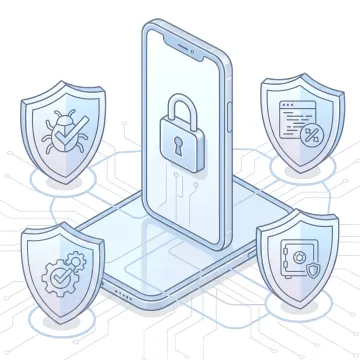
RBI DPSC stands for the Reserve Bank of India's Master Directions on Cyber Resilience and Digital Payment Security Controls. These are mandatory regulatory guidelines issued by the RBI that require banks, NBFCs, payment system operators, and fintech firms to implement specific cybersecurity controls for mobile banking apps, payment platforms, and digital payment infrastructure—covering application security, fraud prevention, device binding, and governance.
What is the RBI special drawing facility?
The RBI Special Drawing Facility (SDF) is a monetary policy tool that allows banks to park surplus liquidity with the Reserve Bank of India at a specific interest rate. While it is distinct from digital payment security regulation, financial institutions subject to SDF must also comply with RBI's broader cybersecurity frameworks, including the DPSC Master Directions, to safeguard their digital and mobile payment infrastructure.
Which types of organizations must comply with RBI DPSC mandates?
RBI DPSC compliance applies to all entities regulated by the Reserve Bank of India that operate digital payment systems. This includes scheduled commercial banks, small finance banks, NBFCs, payment aggregators, prepaid payment instrument issuers, and fintech platforms that process card, UPI, mobile banking, or wallet-based transactions. Non-compliance risks regulatory penalties and reputational damage.
How does AppProtectt help achieve RBI DPSC compliance?
AppProtectt delivers Runtime Application Self-Protection (RASP) with 100+ deep-tech security features through a lightweight SDK for Android and iOS. It directly addresses RBI DPSC controls for application security, including protection against reverse engineering, app tampering, MITM attacks, SMS exploitation, rooted/jailbroken device risks, and unauthorized device binding—enabling rapid, comprehensive compliance with minimal integration effort.
How long does it take to integrate Protectt.ai's RBI DPSC compliance solution?
Protectt.ai's compliance platform is delivered as a lightweight, easy-to-integrate SDK for Android and iOS. Most integrations can be completed in days rather than weeks, with no-code obfuscation options for compiled APKs. The platform is architected for zero performance overhead, ensuring your mobile banking app maintains its user experience quality throughout and after the integration process.
Does Protectt.ai support both Android and iOS mobile banking applications?
Yes. All Protectt.ai solutions—including AppProtectt RASP, AppBind device binding, CodeProtectt obfuscation, and SDK Protectt—fully support both Android and iOS platforms. The platform covers major development frameworks including Java, Kotlin, Ionic, React Native for Android, and Objective-C, Swift for iOS, ensuring comprehensive RBI DPSC compliance coverage regardless of your mobile technology stack.
How does the platform reduce manual compliance and audit preparation work?
Protectt.ai's automated compliance monitoring engine enforces security policies in real time, continuously checking your mobile app's posture against RBI DPSC controls. This automation reduces manual compliance work by up to 80%. Automated report generation transforms what typically requires weeks of manual audit preparation into a near-instant, audit-ready output—significantly lowering internal compliance resource requirements.
What certifications does Protectt.ai hold that validate its compliance capabilities?
Protectt.ai holds ISO 27001 (Information Security Management), ISO 22301 (Business Continuity Management), ISO 42001 (AI Management System), and PCI DSS (Payment Card Industry Data Security Standard) certifications. These internationally recognized standards validate the platform's security rigor and make Protectt.ai a credible, certified partner for Indian financial institutions seeking RBI DPSC compliance.