What is the best way to secure an API?
The most effective API security strategy combines multiple layers: enforce strong authentication (OAuth 2.0, API keys), implement rate limiting and input validation, encrypt all traffic with TLS, and deploy runtime monitoring powered by AI. Regularly audit endpoints against OWASP API Security Top 10, apply least-privilege access controls, and use automated threat intelligence to detect and block anomalous behavior before breaches occur.
Which are the two best practices used to secure APIs?
The two most critical best practices are: (1) Strong Authentication and Authorization — enforcing OAuth 2.0, JWT validation, and object-level access controls to ensure only verified identities reach sensitive endpoints; and (2) Continuous Runtime Monitoring — using AI-powered behavioral analytics to detect anomalies, injection attempts, and data exfiltration in real time, enabling immediate automated response rather than reactive remediation.
What is OWASP Top 10 API Security?
The OWASP API Security Top 10 is an industry-standard framework listing the most critical API vulnerabilities, including Broken Object Level Authorization (BOLA), Broken Authentication, Excessive Data Exposure, Lack of Resource and Rate Limiting, Broken Function Level Authorization, Mass Assignment, Security Misconfiguration, Injection, Improper Asset Management, and Insufficient Logging. Addressing all ten is essential for any enterprise API security program.
How does real-time API protection work?
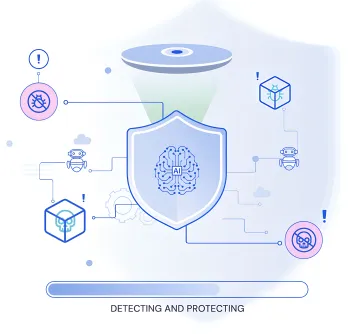
Real-time API protection works by inspecting every API request and response as it occurs, using AI/ML models trained on known attack patterns and behavioral baselines. The system flags and blocks malicious traffic—such as injection payloads, credential stuffing attempts, or unauthorized data access—in milliseconds, ensuring threats are neutralized before they reach backend systems or expose sensitive data.
What compliance standards does the Protectt.ai API Security Platform support?
Protectt.ai is certified under ISO 27001, ISO 42001, ISO 22301, and PCI DSS, and its platform supports compliance with RBI Master Directions, SEBI Cybersecurity Framework, NPCI Security Controls, and GDPR. Automated compliance monitoring and audit report generation reduce manual preparation time by up to 90%, helping regulated enterprises avoid penalties and stay ahead of evolving requirements.
Can the platform integrate with existing API gateways and development workflows?
Yes. Protectt.ai's API security capabilities are designed for seamless integration with existing API gateways, CI/CD pipelines, and development workflows via lightweight SDK and API-based integration points. The platform supports cloud-based and on-premise deployments, delivers zero performance overhead, and is compatible with enterprise systems, banking platforms, mobile applications, and web applications without requiring significant infrastructure changes.
How does Protectt.ai handle false positives in API threat detection?
Protectt.ai's AI/ML-powered detection engine is purpose-built to minimize false positives. By learning legitimate API traffic behavioral baselines specific to your environment, the system distinguishes genuine threats from normal usage patterns with high precision. Highly customizable detection rules allow security teams to fine-tune thresholds, reducing alert fatigue while ensuring that real threats are flagged and blocked accurately and promptly.
Is the API Security Platform suitable for financial and banking sector organizations?
Absolutely. Protectt.ai was designed with financial sector requirements at its core and is already trusted by institutions including RBL Bank, Yes Bank, BSE, Bajaj Finserv, and LIC. The platform addresses sector-specific needs such as transaction API security, regulatory compliance with RBI and SEBI frameworks, fraud prevention, and real-time risk management for payment and banking APIs across mobile and web channels.